
The Florida contractor exam is open book. The people who fail are usually the ones who studied like it was closed book, highlighting every page, building flashcards, and memorizing statutes they were always allowed to bring into the room. What actually gets graded is how fast you find the right answer in the right reference under the clock. Fix that one habit and the exam gets much easier to pass.
TL;DR: Most candidates who fail the Florida contractor exam make one of three study mistakes: highlighting everything, skipping each book’s table of contents and index, or memorizing content for an open-book test. The exam is open book and grades how fast you find the right answer in the approved references, with 70% needed to pass each part. What works is learning each book’s table of contents and indexes, then timing yourself on practice questions until each lookup takes about two minutes.
Table of contents
- The exam grades how fast you find answers
- What the exam looks like on the day
- Mistake #1: Highlighting everything
- Mistake #2: Skipping each book’s table of contents and index
- Mistake #3: Memorizing for an open-book test
- Which book holds the answer
- A study plan that builds lookup speed
- Business and Finance is underestimated
- Free materials fall short
- Steps to getting a building contractor license
- FAQ
- Key takeaways
The Florida contractor exam grades how fast you find answers, not what you memorized
The exam is the last hurdle in how to become a licensed contractor in Florida. Whether you are going for a Florida general contractor (CGC), certified building contractor (CBC), or certified residential contractor (CRC) license, it is open book. You bring the approved references in with you. Nobody is testing whether you memorized a code section. They are testing whether you can read a question, decide which book holds the answer, flip to it, and apply it before the clock runs out.
The framework for the exam is set by Florida Administrative Code 61G4, and the pass line is 70%. That gap between knowing a topic and proving it in the book is where careers stall. Someone who barely knows a subject but can find it in ninety seconds passes. A twenty-year framer who “knows the answer” but takes six minutes to locate it runs out of time and fails.
The Florida licensed contractor requirements go beyond the test itself, covering experience, financial responsibility, and insurance, but the exam is where most candidates stumble. Whatever license you are chasing, from a licensed multifamily general contractor in Florida down to a licensed irrigation contractor, the graded skill in the room is the same: lookup speed.
I passed all three exams on the first attempt, and Paul and I have watched the same three Florida contractor exam mistakes take down experienced tradespeople over and over. The fix is a repeatable lookup routine, which our guide on how to pass the Florida contractor exam walks through step by step.
What the exam looks like on the day
Study the wrong parts and you waste weeks. The DBPR (the Department of Business and Professional Regulation, the state agency that licenses contractors) lays it out this way.
- Three parts. Business and Finance, Contract Administration, and Project Management.
- Business and Finance runs 6.5 hours as its own separate sitting; Contract Administration and Project Management are given the same day.
- Open book. You bring DBPR-approved reference editions into the center.
- Vendor is Pearson VUE. Testing happens at sites across the state.
- 70% to pass each part.
- Retake only what you failed, not the whole thing.
- Four-year window. Finish all parts within four years of your first attempt or your prior scores expire.
Per the DBPR CILB Candidate Information Booklet, Business and Finance is 120 questions over 6.5 hours; the trade parts run 45 to 60 questions each by license (CGC 60, CBC 50, CRC 45) over 4.5 hours, all at 70% to pass. Confirm the current edition before you sit.
You book each part through Pearson VUE. Because there is no fixed statewide Florida general contractor exam schedule, you pick your own dates through the vendor. Use the Pearson VUE site linked above to schedule and confirm the current setup; I will not hand you a phone number I cannot verify.
Mistake #1: Highlighting everything instead of learning where answers live

The logic feels right: highlight everything important so you can spot it fast on exam day. It backfires. Week one you mark key definitions. Week two more things look important. By week three roughly 60% of the book is yellow, and when a whole page glows, nothing stands out. You end up scanning for five minutes on a question you should have closed in two.
Highlight almost nothing. The exceptions worth marking live in the front and back of each book: the table of contents, the indexes (most of these books have more than one), the glossaries, and a handful of statute anchors. Everything else is time you should have spent learning the book’s layout so you can jump straight to the section a question points to.
Mistake #2: Skipping each book’s table of contents and index
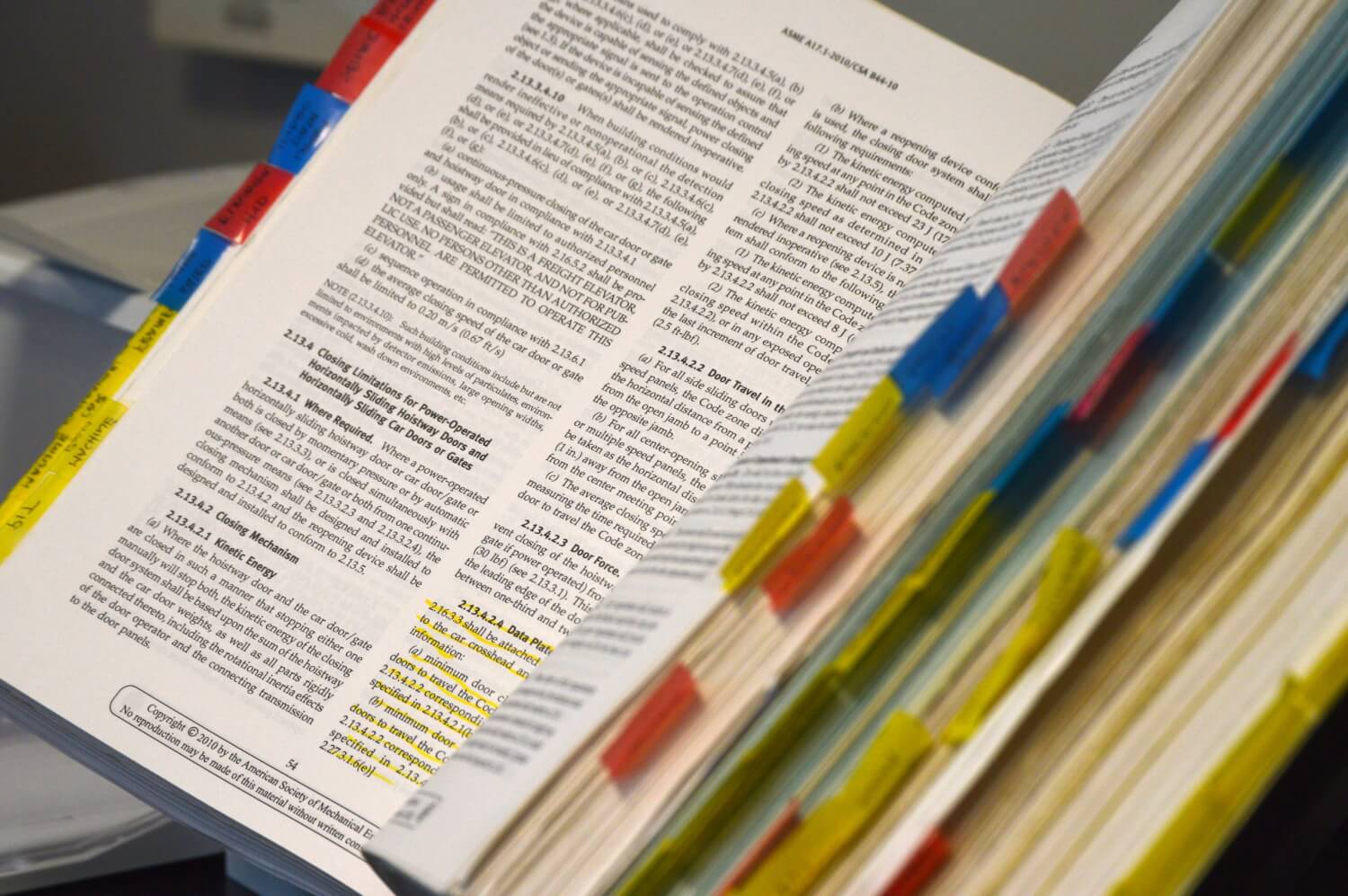
Many candidates open a book only when a question stumps them and never learn how it is laid out. Each approved reference has its own table of contents and index, and under time pressure those are the quickest way to find an answer.
Spend your study time on real practice questions instead, finding each answer through the book’s table of contents and index.
Mistake #3: Memorizing content for an open-book test
Some candidates attack this like a college final: read it all, build flashcards, try to internalize the statutes. It is exhausting and pointless, because you can carry all of it into the room. Recall is not the skill being scored.
What it actually tests is a short, specific set of moves: figure out what a question is asking, decide which book holds the answer, get to the right section, read and apply it correctly, and recognize which questions to skip and circle back to at the end. Memorization touches none of that. Worse, it hands you false confidence. You feel ready because you “know the material,” so you never build the navigation and interpretation that decide the outcome.
Which book holds the answer: the exam-room reference map
Before exam day you should know, on sight, which reference answers which type of question, so a question never starts with “where do I even look?” The parts map to the books like this. Our guide to the Florida contractor exam books lays out the full set by exam part.
- Contract Administration: the Florida Contractor Manual and the AIA Document Bundle (the standard construction contract forms). Contract and payment questions live here.
- Project Management: the Florida Building Code volumes plus OSHA safety references and Principles and Practices of Commercial Construction. Code, safety, and field-execution questions land here.
- Business and Finance: the Builder’s Guide to Accounting. Accounting, overhead, ratios, and markup questions all point here.
The Florida Building Code is not one book. It splits into separate volumes, and knowing which one a question lives in is half the battle. We carry the Building volume (Florida Building Code: Building), plus Residential, Existing Building, Energy Conservation, and Accessibility. Roughly: new commercial and general structural questions go to Building; one- and two-family home questions go to Residential; work on an existing structure goes to Existing Building; insulation and efficiency questions go to Energy Conservation; and clearances and ramp questions go to Accessibility. You will also want the Florida Statutes 2024 edition for lien and licensing questions.
Drill the lookup like a stopwatch event. Take a practice question, name the volume out loud, open its table of contents or index, and find the answer in under about two minutes. Do that enough and the classification becomes automatic before you ever sit down at the center.
A study plan that builds lookup speed, not a bigger pile of flashcards
Plenty of well-prepared people still fail parts, and a plan built around navigation beats one built around memorization every time. Eight to twelve weeks is a reasonable range; adjust it to your field experience.
- Weeks 1 to 2, learn the architecture. Fifteen minutes a day in each book’s table of contents, another fifteen in the indexes, with the actual reference open in front of you. Learn how each book is built and what lives where.
- Weeks 3 to 4, classify questions. Work practice questions and, before solving each one, name it: this is an accounting question, this is a contracts question, this is a code question. Then match it to a book and chapter.
- Weeks 5 to 6 and on, build speed. Time yourself getting from question to answer using the table of contents and index. Push toward roughly two minutes per lookup until it is reflex.
- The day before, rest. Take it fully off. Burnout costs more points than one more cram session ever adds.
One habit helps throughout: for each question, name the book you think holds the answer, and the book it has to be in if it is not there. Overhead expenses go to the accounting guide first; if they are not there, you already know your backup.
Business and Finance is the part experienced builders underestimate
Seasoned trades assume field knowledge carries them, then get humbled by Business and Finance. This separate sitting is heavy on accounting, financial ratios, and the difference between markup and margin, none of which are skills you build on a jobsite.
Do not try to fold that math into your general study. Drill it on its own, with real B&F practice problems, and work the accounting reference until the calculations are routine. We keep the ratio and markup detail on our Business and Finance test-prep material rather than dumping tables here, so treat this part as its own project.
Free materials fall short
The board-approved, current editions you must bring into the room are the reason free materials rarely get anyone through. Free materials will not match the up-to-date volumes you actually flip through during the test, and if the edition is wrong, the page numbers and layout you practiced on are useless.
The bigger gap is practice questions. Free sources rarely include real, exam-style questions with the classification and timing work that builds lookup speed, and that is what is worth paying for.
Steps to getting a building contractor license in Florida
The exam is one step in getting a GC license in Florida, and the same steps apply to the CBC and CRC. Here are the requirements in the order most applicants meet them.
- Step 1, basic eligibility. You must be at least 18 and of good moral character (F.S. 489.111).
- Step 2, experience. Meet one route: at least four years of active experience as a worker with at least one year as a foreman; a related bachelor’s degree plus one year of proven experience; or one year as a foreman plus three years of accredited college credits.
- Step 3, the three exams. Pass Business and Finance, Contract Administration and Project Management at 70% each, within four years of your first attempt.
- Step 4, insurance and finances. File an affidavit covering workers’ compensation, public liability and property damage insurance, plus a credit report that shows financial responsibility (F.S. 489.115).
That is the full path to a licensed contractor in Florida. Most of the study work sits in Step 3, which is why the lookup habits above matter more than any single book.
FAQ
Key takeaways
- Study for retrieval speed, not recall; the exam is open book and grades how fast you find answers.
- Stop highlighting past the table of contents, indexes, glossaries, and a few statute anchors.
- Learn each book’s table of contents and index, and spend your study time on practice questions.
- Learn the book-to-part map so no question starts with “where do I look?”
- Give Business and Finance its own drilling; it is a separate 6.5-hour exam that catches experienced trades.
Sources: Florida Statutes Chapter 489; Florida Administrative Code 61G4-16; DBPR Construction Industry FAQ; Florida Building Code; Pearson VUE.
Related: the reference books that actually matter, and how the prep options compare.


